
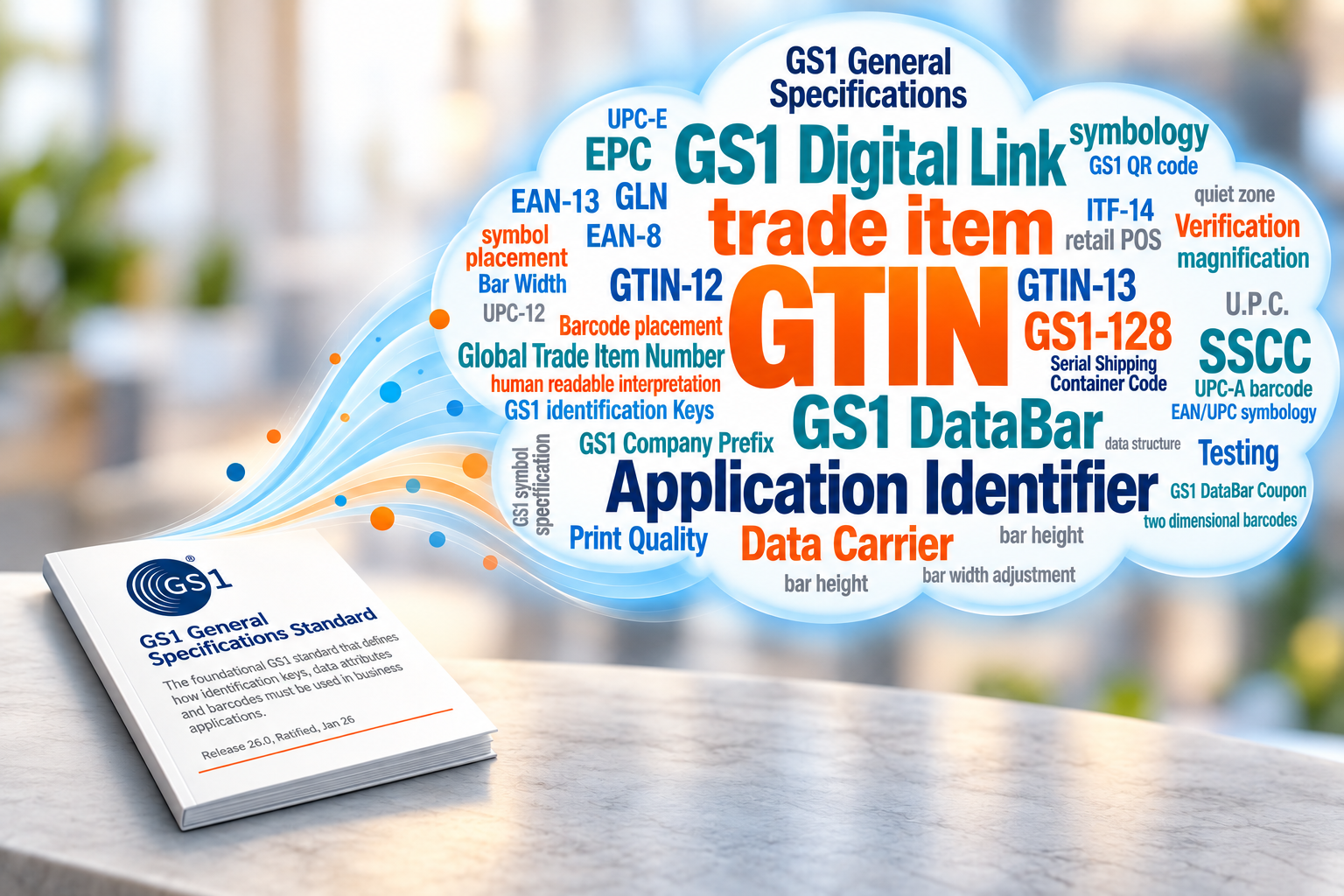
Second only to the current president of the United States, GS1 is a master of self-promotion and branding. Pretty everything involving standardized barcoding is preceded with GS1 (GS1 Company Prefix, GS1 QR Code, GS1 Digital Link, GS1-128, etc.). In case you are on a desert island, GS1 is a global standards organization whose identification and data standards provide a common language for trading partners.
But there is another part of GS1 that receives far less attention—and arguably does much of the heavy lifting. It is called the GS1 General Specifications.
At the center of the GS1 organization is the GS1 General Specifications: the foundational global standard defining how GS1 identification keys, data attributes and barcode symbols are to be used.
GS1’s strength is not providing implementation tools and services, but rather harnessing input from various stakeholders and creating a common language that securely bridges the physical and digital worlds, enabling businesses to seamlessly exchange trusted data.
Whether you are a retailer, manufacturer, solution provider or printer, GS1 General Specifications provides the necessary granular details that have enabled standardized global barcode identification. Since the inception of the UPC, we have actively contributed to the UCC/GS1 standards/guidelines and is the foundation for all our offerings. As GS1 standards are now integrated throughout various industries and supply chains, the devil is truly in the details to maintain compliance.
The Number Is Only the Beginning
A GTIN identifies a product. But assigning an identification number does not determine everything required to create a properly constructed barcode or ensure that the barcode will perform after it is printed.
The GS1 General Specifications go much further.
They establish requirements governing barcode symbologies, dimensions, X-dimensions, quiet zones, symbol height, placement, and application-specific requirements. They also contain the Symbol Specification Tables that establish the barcode requirements for different GS1 applications.
And importantly, the General Specifications address something that is often overlooked today: the physical realities of printing a barcode.
From a Digital Barcode to a Print-Ready Barcode
Printing is not a perfect reproduction process.
Depending on the printing method, press, substrate, and other production conditions, printed bars can become wider or narrower than the bars contained in the original digital barcode master.
The GS1 General Specifications specifically address this phenomenon. For conventional printing processes, they call for evaluating bar gain or loss to determine the appropriate Bar Width Adjustment (BWA). When printing causes bars to become wider, the digital master can incorporate Bar Width Reduction (BWR) to compensate.
Section 5.12.4.2 of the current 2026 General Specifications says that for conventional printing, the process must determine bar gain/loss to decide the appropriate bar width adjustment (BWA); when bar gain occurs, the master image needs adjustment to compensate. It further recommends that the master image be accompanied by its X-dimension and selected BWR.
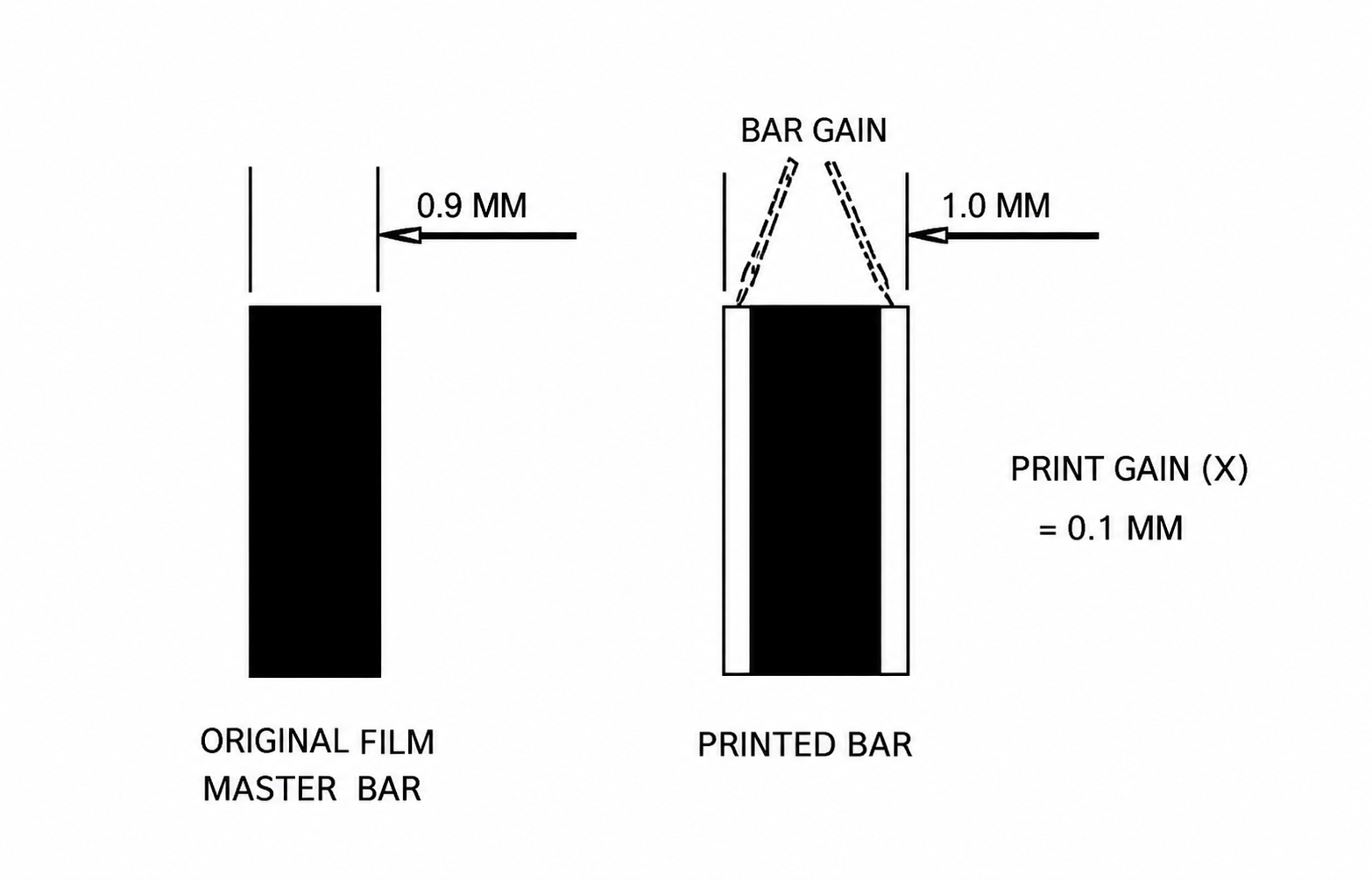
This is central to the definition of a Print-Ready Digital Barcode and is a precision barcode master prepared for production, including the appropriate BWR when required for the intended printing process.
Most online barcode generators, including those from GS1(ie. GS1 Datahub), simply provide a barcode saved as an EPS or other high-resolution vector file. Vector describes a file format. Print-ready describes preparation for production.
Vector describes a file format. Print-ready describes preparation for production.
That difference has been fundamental to our PrecisionCode® barcode artwork technology since 2001. Our web-based barcode engine is derived directly from the UCC & GS1 technical guidelines and is the only software to become UCC/EAN (GS1) certified for barcode artwork.
The Standard Continues Through Barcode Testing
The General Specifications do not solely define barcode creation. They also establish requirements for evaluating the finished printed barcode symbols.
GS1 barcode quality builds upon internationally recognized ISO/IEC barcode print-quality methodologies, while the GS1 General Specifications establish additional application requirements and Symbol Specification Tables. Verification therefore examines more than whether a scanner can simply read a barcode.
That same standards-based approach is the foundation of Bar Code Graphics’ Conformance Certification testing protocols.
Our testing evaluates printed barcodes against applicable GS1 requirements, ISO barcode print-quality parameters and, where applicable, specific retailer or trading-partner requirements.
There is a logical progression:
Identification → Barcode Creation → Printing → Verification → Conformance
Each stage is different, but the common foundation is the standard.
Standards Matter More Than the Logo
The GS1 name is recognized throughout global commerce. But companies working with barcodes should also understand the standards behind that name.
For more than 51 years, the GS1 system has provided a common global framework that allows products, shipments, locations, and other objects to be identified and captured consistently throughout the supply chain.
The GS1 General Specifications are the technical foundation that turns that concept into something manufacturers, printers, retailers and technology providers can actually implement.
At Bar Code Graphics, that distinction is important to us.
Whether we are creating a Print-Ready Digital Barcode with appropriate BWR or testing a finished symbol through our Conformance Certification services, our objective is the same:
Start with the global standard—and measure the result against the standard.





Comments are closed.