
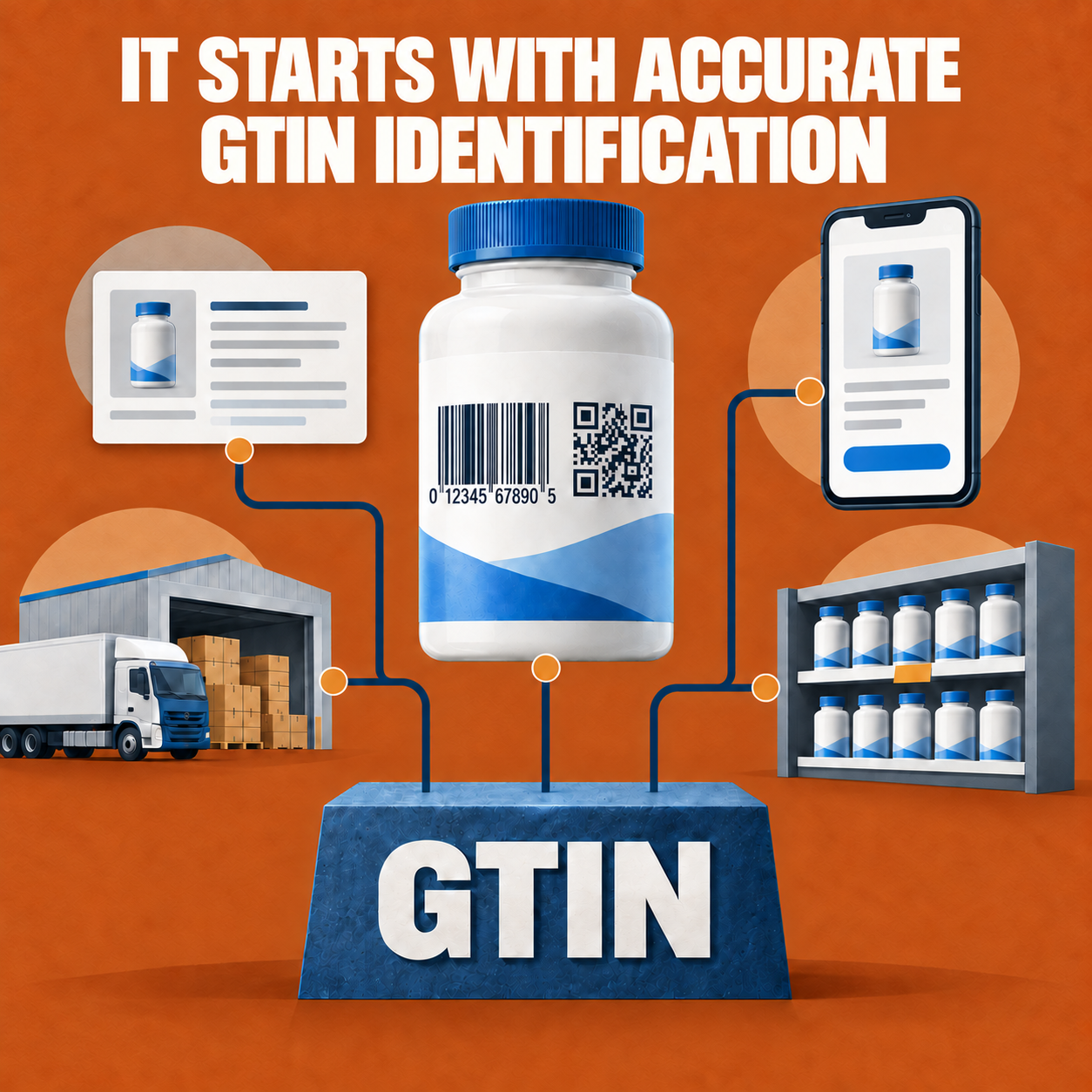
Today, most blogs and LinkedIn posts are focusing on the GS1 Digital Link and Sunrise 2027. The benefits from this initiative are amazing and overwhelming. Companies exploring GS1 Digital Link often begin with the same questions: Which QR code should we use? Which solution provider should we choose? Where should the code direct consumers? Who will manage the content? Can our printer reproduce the barcode correctly?
Those are important questions—but they are not the first question.
The first is whether the product has been assigned the correct Global Trade Item Number (GTIN).
If the GTIN is wrong, nothing downstream can correct it—not the QR code, the resolver, or the retailer’s systems. The implementation may scan correctly and open the intended webpage while still being built on the wrong product identity.
A GS1 US case study featuring Target, Keurig, and Pilot Pen demonstrates what happens when product data enters the supply chain without being properly validated.
What a GTIN actually does
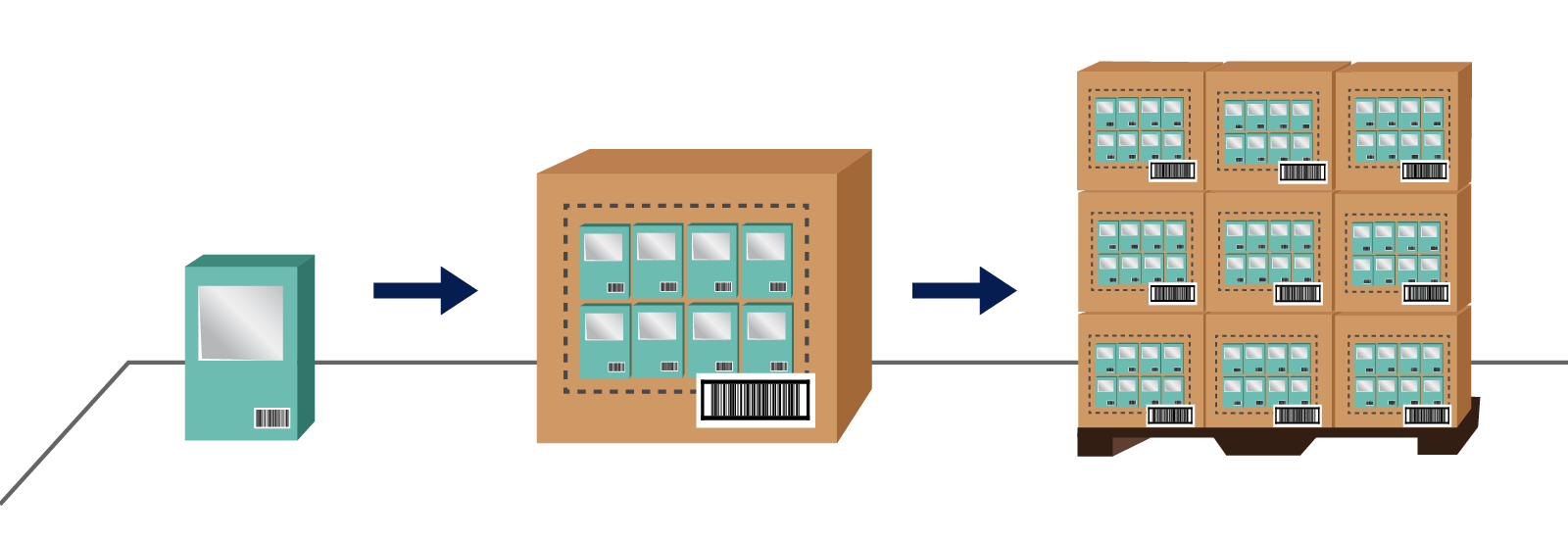
A Global Trade Item Number identifies a trade item, not a barcode and not a listing. GS1 describes it as the connector between a physical product and its digital information, used everywhere from checkout to recalls to reordering. In a GS1 Digital Link URI, the GTIN establishes which physical product a string of data belongs to. A lot number, an expiration date, or a variant can attach to that identity, but only once the identity itself is right.
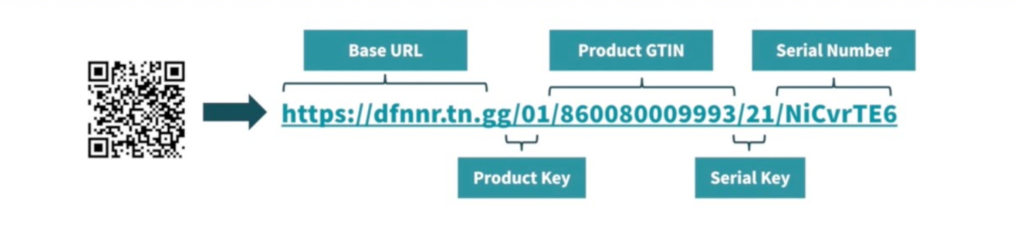
GS1’s current 2D barcode implementation guidance names the GTIN as essential to product identification, point-of-sale transactions, data accuracy, supply-chain visibility, and e-commerce: five different systems, all inheriting whatever went wrong at assignment.
What the GS1 US Case Study Reveals
The GS1 US case study is not about Digital Link or QR codes. It is about the operational and financial consequences of inaccurate product data.
When Target began measuring supplier data instead of assuming it was correct, only three percent of suppliers passed verification on the first attempt. A benchmark audit of 1,700 cases found that shipping weights were accurate only 71.4 percent of the time.
Even small discrepancies produced significant consequences. According to the study, a case-height error of just one-quarter inch reduced the capacity of a truckload by 1,000 cases and required six additional trucks to transport the same volume of merchandise.
Target director Jason Lavik summarized the lesson clearly: “You just can’t assume your data is good. You have to measure it.”
Keurig applies that principle through quarterly audits, more comprehensive reviews twice a year, and spot checks following product launches. The company recognizes that inaccurate dimensions can disrupt operations throughout the supply chain.
Pilot Pen introduced verified weight and dimensional measurements before products leave its warehouse. The company reported lower chargeback costs and emphasized that data quality must be treated as a company-wide responsibility—not simply an IT function.
The common problem was not a barcode that failed to scan. It was unverified data affecting freight, inventory, shelf space, ordering, and revenue.
Jason Lavik, a director at Target, put it plainly: “You just can’t assume your data is good. You have to measure it.” Angela Schulz, a senior director there, was blunter about the stakes for suppliers who don’t: “You may even become obsolete.”
None of that is about a barcode scanning wrong. It’s freight, shelf space, and inventory built on numbers nobody had checked.
Keurig treats the fix as a standing job rather than a project. Eileen Hanafin, Keurig’s director of master data management, runs quarterly audits, a more thorough pass twice a year, and spot checks after every launch, because, in her words, “if a product is listed with inaccurate dimensions, it may cause disruptions across the supply chain.” Sales specialist Ashley Whaley ties the discipline directly to revenue: “Complete, accurate data has become important for our company and as a supplier for Target.”
Why This Matters for GTIN Management
The case study illustrates a broader rule: product data must be checked before other systems begin relying on it.
That rule is especially important for GTINs because the GTIN serves as the identifier connecting the product to those systems. A weight or dimension can be corrected. An improperly structured product-identification hierarchy can spread across packaging, retailer item files, digital content, and supply-chain records before anyone recognizes the problem.
Companies should confirm:
- Which products and configurations require unique GTINs
- How variations such as size, color, quantity, or formulation are identified
- How consumer units, inner packs, cases, and pallets relate to one another
- Whether existing assignments are consistent across internal and retailer systems
- Whether the GTIN structure will support the intended GS1 Digital Link implementation
These decisions should be reviewed before a QR code is created or packaging artwork is approved.
A System Does Not Replace a Validation Process
The case study does not blame any particular GTIN-management system, and the risk is not limited to spreadsheets.
A spreadsheet can make assignments difficult to control because it may lack automated validation, defined permissions, duplicate detection, and a reliable audit history. Knowledge may also disappear when the employee who created or maintained the file leaves the organization.
GS1 US Data Hub provides more structure for creating and managing GTIN records, but using a structured system does not eliminate the need for sound assignment practices and independent review. In fact, this free tool does not provide any form of data accuracy validation at all. It simply is looking for data provided in appropriate fields. Our GS1 barcode consultants routinely see duplicate product descriptions entered in product data for numerous GTINs.
Aside from ongoing personal support, the main reason brands use GTIN.cloud is that it acts as both a GTIN management portal, but also includes human review of all GTIN and product data before publishing.
A system can validate format and required fields; it cannot always determine whether a company selected the correct packaging level, applied the GTIN Management Standard properly, or created the right relationship between a consumer unit and its cases.
The real issue is not simply which tool a company uses. It is whether assignments are governed, documented, reviewed, and tested before they reach the marketplace.
A QR Code Cannot Correct an Identification Error
A QR code is a data carrier. It encodes information, but it cannot determine whether the GTIN inside that information was assigned correctly.
Once an incorrect GTIN enters the process, it can appear in:
- Product-data platforms
- GS1 Digital Link URIs
- Linear and 2D barcodes
- Packaging artwork
- Retailer item records
- Inventory and ordering systems
- E-commerce listings
- Consumer experiences
- Traceability applications
The code may scan. The webpage may load. The implementation may appear complete. It can still identify the wrong product.
Scanning successfully is not the same as functioning correctly.
It is also important to distinguish identification from formatting. The GS1 Digital Link URI syntax requires a GTIN to be expressed as 14 digits, using leading zeroes when necessary. Those zeroes only provide the required format. They do not create a new GTIN, correct a bad assignment, or turn a consumer-unit GTIN into a case-level GTIN.
Formatting cannot repair an identification error.
Get the Foundation Right Before Adding the Technology
GTIN Implementation Support should come before QR-code generation. The purpose is to confirm that products, variations, packaging levels, and existing identifiers have been structured correctly before those identifiers are distributed across new systems.
That is the work Bar Code Graphics performs through GS1 Barcode Support: identifying problems while they are still inexpensive to correct.
Barcode and implementation testing follow—but they serve a different purpose.
Barcode verification evaluates whether the printed symbol is likely to scan properly. GS1 Digital Link testing must also determine whether:
- The correct data has been encoded
- The URI has been constructed properly
- The linear and 2D barcodes identify the same product
- Size, quiet zones, placement, and print quality meet requirements
- The code performs correctly at point of sale
- The scan reaches the intended digital destination
Bar Code Graphics supports both sides of the process: the physical barcode and the implementation behind it.
A barcode that scans but contains the wrong data is still a failure. A barcode that verifies but directs users to the wrong destination is also a failure.
The Foundation Is Five Pillars of Information
GS1 develops the standards. Solution providers build QR-code platforms and consumer experiences. Data-management companies organize product information. Printers reproduce the symbols. Retailers scan them.
None of those participants can compensate for an incorrect product identity.
Before selecting a platform or sending packaging artwork to print, confirm:
- The right product.
- The right GTIN.
- The right data.
- The right barcode.
- The right destination.
Get those in order first. Everything built on top, Digital Link included, depends on it.
Sources
GS1 US: Target, Keurig, and Pilot Pen Data Quality Journeys (case study PDF)





Comments are closed.