
Bar Code Graphics has run barcode certification and compliance programs for major US retailers and manufacturers since 1998. Retail has changed a lot in that time, and supply chain efficiency carries more weight now than it did when we started. Some vendors assume compliance fees are just a profit center for retailers. We test as an independent lab, not as the party collecting the fee, and the infractions we process hold up under scrutiny. Retailers who use our compliance administration services give us the standing to support legitimate offsets and protect their suppliers from inaccurate reporting.
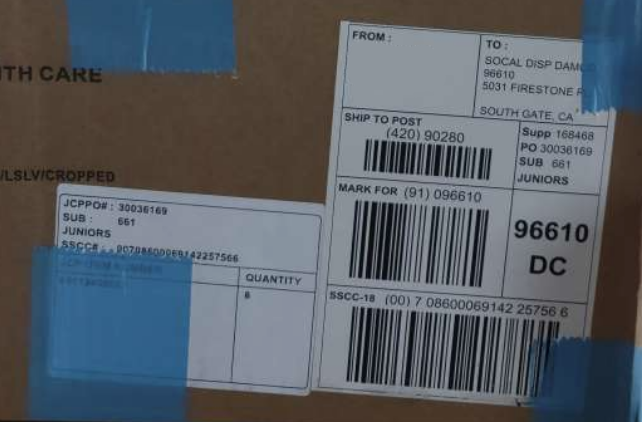
Our barcode compliance division is seeing a growing percentage of problematic shipments involving shipping label placement issues, rather than print quality infractions. Placement-related infractions can range from placing labels on an incorrect carton panel, wrapping barcodes around corners, placing labels over a flap seam, and even placing labels in areas in which they are impacted by tape. It is important to note that, due to varying sortation scanning environments, tape of any color may have an adverse impact on scanning performance.
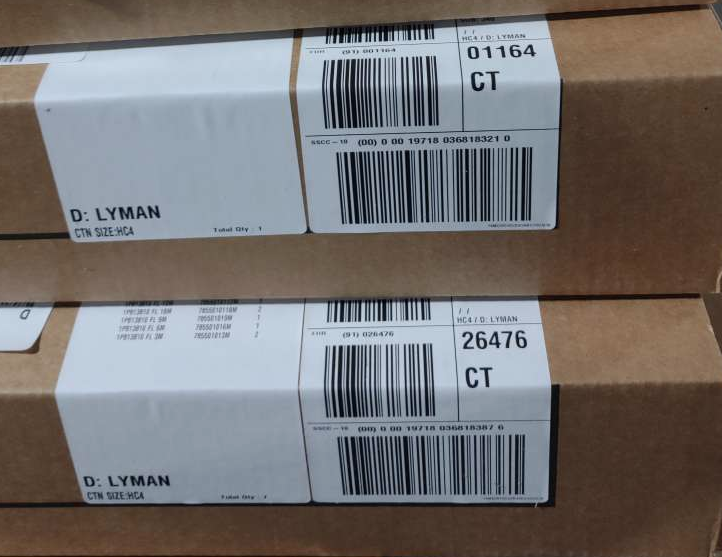
It is very common for warehouse and shipping positions to have a high level of employee turnover. Consequently, suppliers are encouraged to elevate their training to include visual examples of best practices and specific trading partner requirements. The sad reality is that $0.25 labels created and placed by a company’s lowest-paid employees can result in legitimate offsets of tens of thousands of dollars.
Our retail partners ask their vendors to test POS and GS1-128 barcodes on a regular basis, since software updates, new hardware, and material changes can all break a barcode that scanned fine the month before. This year, our testing division, Identification Labs, evaluated thousands of supplier GS1-128 shipping labels for retailers outside our existing partnerships. In most of those cases, the retailer charges compliance fees without giving suppliers the ISO/ANSI certification support they’d need to actually meet the standard.
GS1-128 Shipping Label Best Practices
- Routinely review your trading partners’ requirements. Convey this information to key personnel at your company. For example, Home Depot, JCPenney and Kohls suppliers are encouraged to visit their web portal weekly.
- Do not assume your company is in compliance. Confirm your company’s compliance by certifying your GS1-128 shipping labels. New personnel and system changes require updated certification for each retailer whose business you value. A $75 testing/certification fee can prevent unnecessary compliance offsets. We consistently see an increase in label defects from previously certified suppliers who made changes to their label material. Also, make sure samples are provided for each ship location. It is very common for larger companies to have multiple shipping locations.

- Emphasis the importance of GS1-128 Shipping Label Placement to all personnel responsible for handling cartons. Placement requirements vary among retailers so education is key.
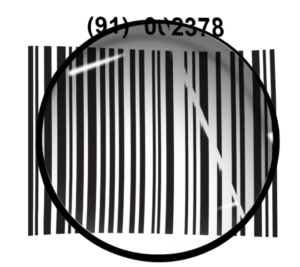 Perform routine maintenance on printing equipment and confirm supplies are suitable for your application. If you are having issues with print quality, changing your print heads may solve the problem. We also recommend you always have spare print heads in-house at all times. Print quality infractions account for the largest percentage of GS1-128 issues and can be eliminated by proactive quality control that ensures consistent label compliance.
For the retailers that we partner with, we’re able to promote and guide suppliers to certification immediately after any shipping label-related compliance issues. In some cases, re-certification is simply built into the compliance process – if a label fails in the supply chain that means you automatically need to certify a corrected sample.
Bar Code Graphics is a leader in barcode print quality and is the largest North American barcode testing center for POS and shipping labels. Please feel free to call us at 800.662.0701 x310 or email us at support@barcode-us.com.
Frequently Asked Questions
For shipping labels, increasingly yes. Print quality infractions still account for the largest single category of GS1-128 issues overall, but placement-related failures (wrong panel, wrapped corners, tape coverage) have grown into a substantial share of what compliance teams now flag, even on labels that print cleanly.
It can. Scanning performance depends on the sortation environment a shipment passes through, and clear, white, and colored tape can all interfere with a scan depending on the scanner type and lighting. There’s no tape color that’s automatically safe to place over a barcode.
Test after any change to printing software, hardware, or label/ribbon material, and on a recurring schedule even without a known change. Retailers update their requirements periodically, and previously certified suppliers often see defect rates rise after a material switch they didn’t think to retest.
Some retailers outsource enforcement but not education, which leaves suppliers paying fees without a clear path to fixing the underlying issue. This is a common reason suppliers come to Bar Code Graphics even when we have no formal partnership with the retailer involved.
We test as an independent lab, not as the party collecting the fee. Due to our unique experience and expertise, we are regarded as the print quality experts and our services are used by various industries. When we administer a retailer’s compliance program, we evaluate the actual label or shipment against the ISO/ANSI standard and the retailer’s own specification, which lets us support legitimate offsets and push back on ones that don’t hold up.





Comments are closed.